I.Introduction
Disagreements are an inevitable part of the Supreme Court of Canada and, indeed, of all high courts. In fact, a consistently unanimous court could never exist at that level. Judges disagree with one another, and they express those disagreements either in concurring opinions, when they agree with the outcome but not with the analysis, or in dissenting opinions, when they disagree with the majority entirely. Dissents, especially at the Supreme Court level, are powerful and indicate, at the very least, the dissenting judge’s unwillingness to accept the majority’s opinion. Some judges write dissenting opinions in the hope that the matter will be revisited one day and that the law in question will be changed or overturned.1 A clear example is the recent overturning of Roe v Wade2 by the United States Supreme Court in Dobbs.3
1.Why judges should (and should not) dissent
There are several arguments as to whether judges on a high court should dissent. Some argue that judges must be satisfied with the outcome of a decision before signing on to its reasons, as this ensures that they have discharged their judicial responsibility.4 On this view, signing on to a decision with which a judge does not fully agree is an abdication of judicial responsibility. Declining to dissent despite disagreeing with a judgment can also create a sense of “false unanimity,” which may lead judges to compromise on expressing their true opinions and, consequently, may result in the suppression of useful information.5 Justice Ian Binnie, in his exit interview with The Globe and Mail, stated that showing disagreement is “extremely useful to tell the legal community and the broader public that there is a real debate going on among the judges and displaying the different contending points of view – much healthier than a false show of unanimity because it enables commentators to weigh in with fresh insights and eventually get these controversies resolved.”6 At the same time, dissents, and disagreements in general, are said to create more work, not only for the dissenting judge but also for the majority, who must respond to the dissent.7
On the other hand, some regard unanimity within the Supreme Court as a sign of the Court’s strength. Former Chief Justice Dickson stated that, even though reaching a unanimous decision might require setting aside some of the issues on which there was no agreement, “it might be necessary to pass up the benefits to be had from discussion about fine points of difference between various colleagues ... [in order to reach a unanimous decision on an issue that requires] a clear and firm statement of principle from the court.”8 In general, judges tend to dissent when the benefit derived from dissenting exceeds the cost incurred in effort and lost collegiality.9
2.Why do judges dissent?
While the question of whether judges should dissent is largely theoretical, the study of why judges dissent is highly complex and requires analytical methods capable of uncovering judicial behaviour. This paper seeks to understand why and when judges at the Supreme Court of Canada (SCC) disagree. In other words, which factors are relevant to understanding the judicial behaviour of dissenting? This paper argues that the answer to why judges dissent is not simply “because they disagree with the outcome,” and that other factors can help predict when a particular judge or group of judges will dissent or refrain from dissenting.
Using computer programming, this paper analyzes data gathered from SCC cases decided since 1976 and provides visual data analytics to help explain the trends in judicial dissent at the SCC. The Court has seen a general increase in its dissent rate over the years, and this paper evaluates why this is the case. The paper finds that the SCC’s annual caseload is inversely correlated with the rate of dissent, meaning that the lower the caseload in a given year, the greater the likelihood of a high dissent rate. By contrast, the number of judges sitting on the panel is directly proportional to the dissent rate, meaning that a 9-judge panel carries a higher likelihood of dissent than a 7-, 5-, or 3-judge panel. Furthermore, the arrival of female judges and party affiliations are found to make no significant difference to the rate of dissent at the SCC. These factors, together with certain external developments, such as the arrival of the Charter at the beginning of the 1980s, the arrival of more technologically advanced cases at the SCC, and the unusually high dissent rates of some judges, such as Justice Côté, can potentially explain the increasing rate of dissent at the SCC.
II.The Data
The data used for this analysis was gathered from CanLII and includes all SCC cases from 1976 to 2021. The year 1976 was chosen specifically because it was the first full year after the amendments to the Supreme Court Act10 broadened the Court’s discretionary jurisdiction by eliminating appeals as of right in civil cases, limiting them in criminal cases, and restricting leave to appeal to cases of public importance.11 In total, 4,158 cases are included in the analysis. The text of each case was analyzed using Natural Language Processing and Regular Expressions to extract various data points, such as the judges present, the dissenting judges, the authors of the majority and dissenting reasons, the area(s) of law involved, the jurisdiction from which the case reached the Court, the outcome of the appeal, and the method by which the decision was delivered (written or oral). The data also includes information on all the judges who sat during the years covered, including their gender, the party of the government that appointed them to the Court, and the jurisdiction from which they were appointed, if any.
The data has also been filtered to allow for meaningful analysis. For example, most motion and application cases, which are very short and add no useful information to the analysis, have been removed. Different areas of law are also distinguished in the data; however, these categories are not mutually exclusive. Criminal cases, for instance, can also be constitutional cases, and private law cases cover civil matters such as torts, contracts, and intellectual property.
It is also worth noting that, as with any computer program, the data may contain some errors; the analysis, however, proceeds on the assumption that the collected data and the computer program used for the data analytics are correct.
III.Some Preliminary Dissent Trends at the SCC
To better understand the dissenting behaviour of judges, it is necessary to evaluate some preliminary data about the SCC. This will provide a clearer picture of the phenomenon of dissent and of how different factors affect it.
1.Overall dissent rate trend
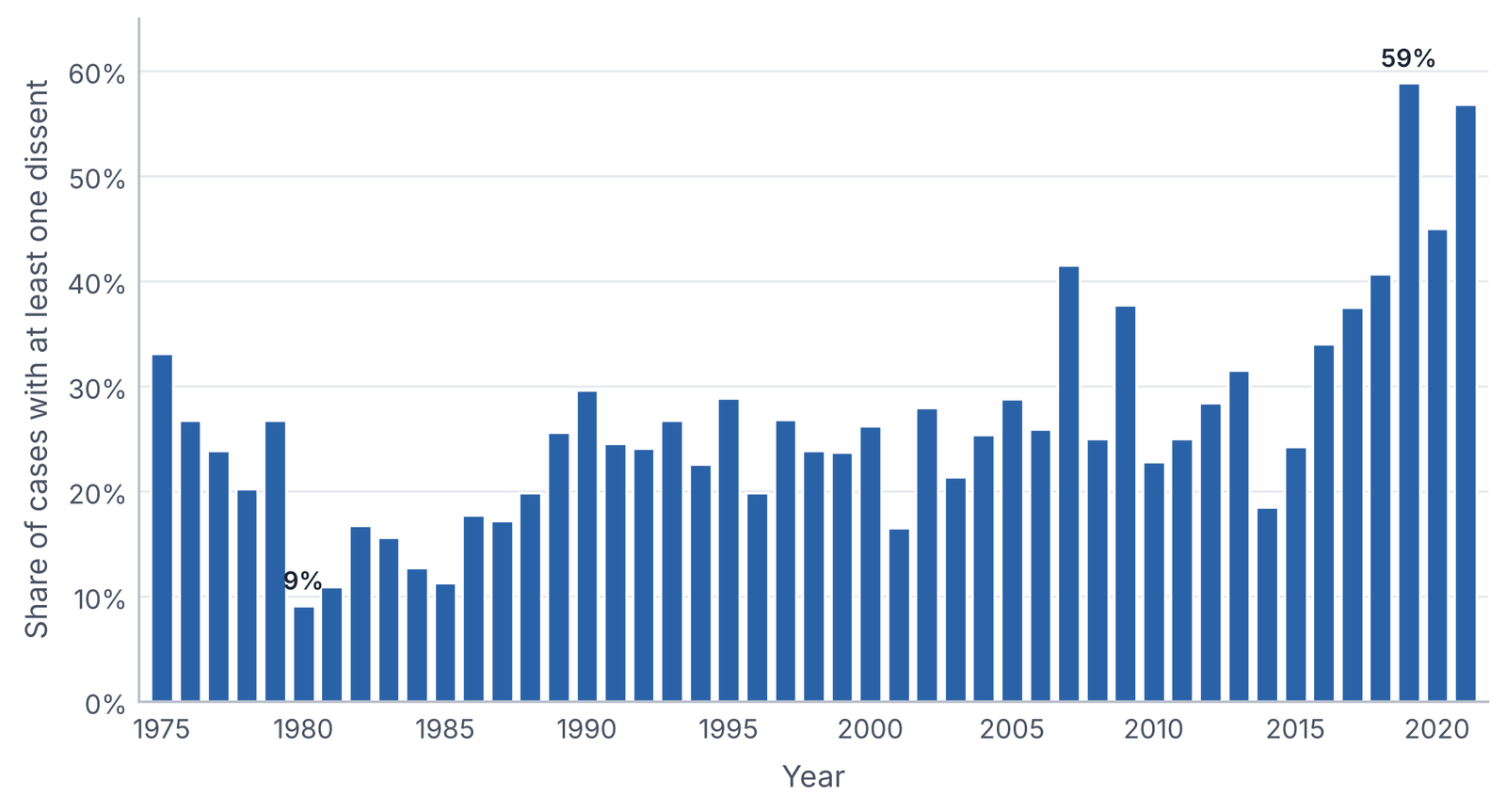
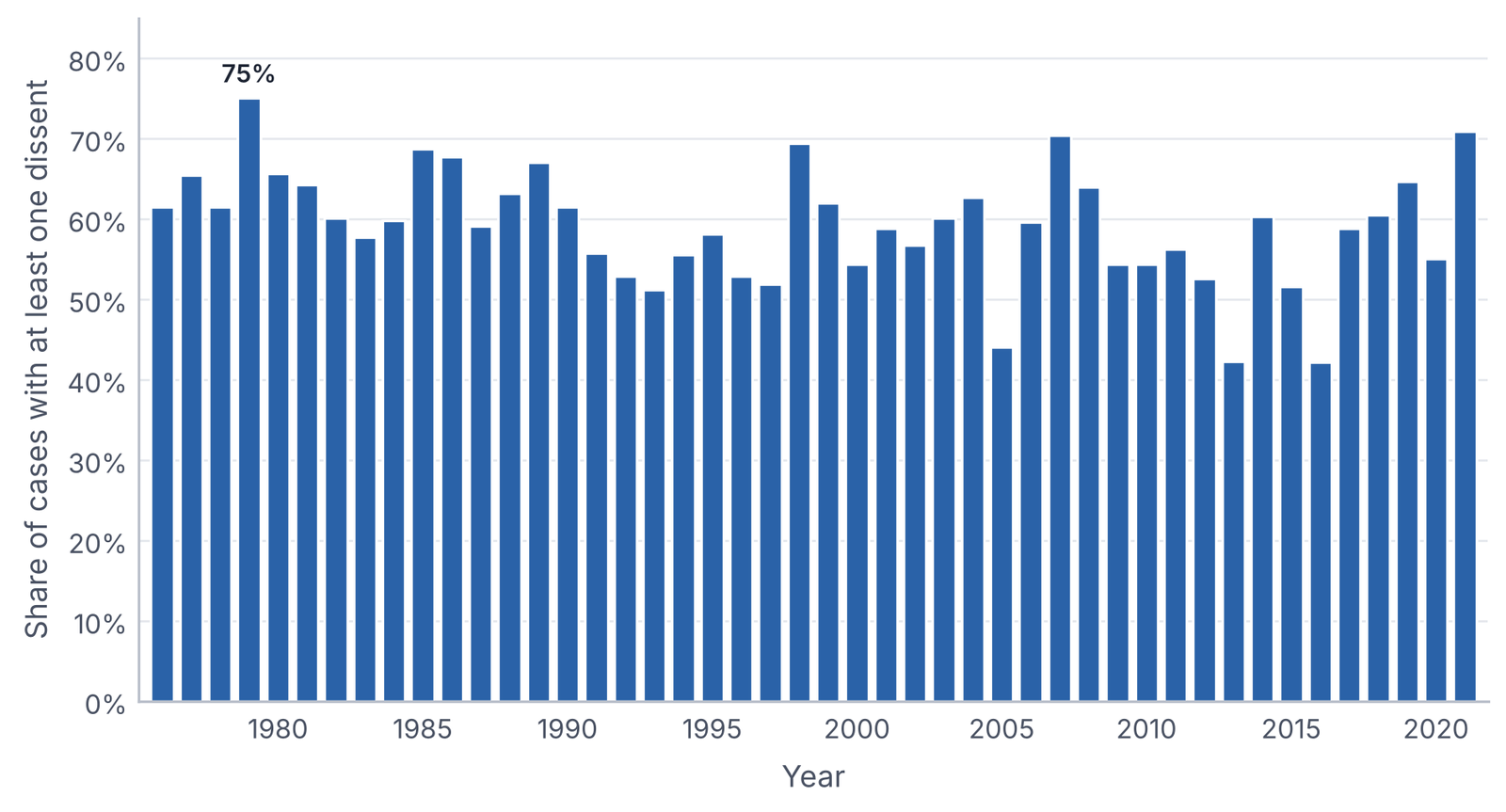
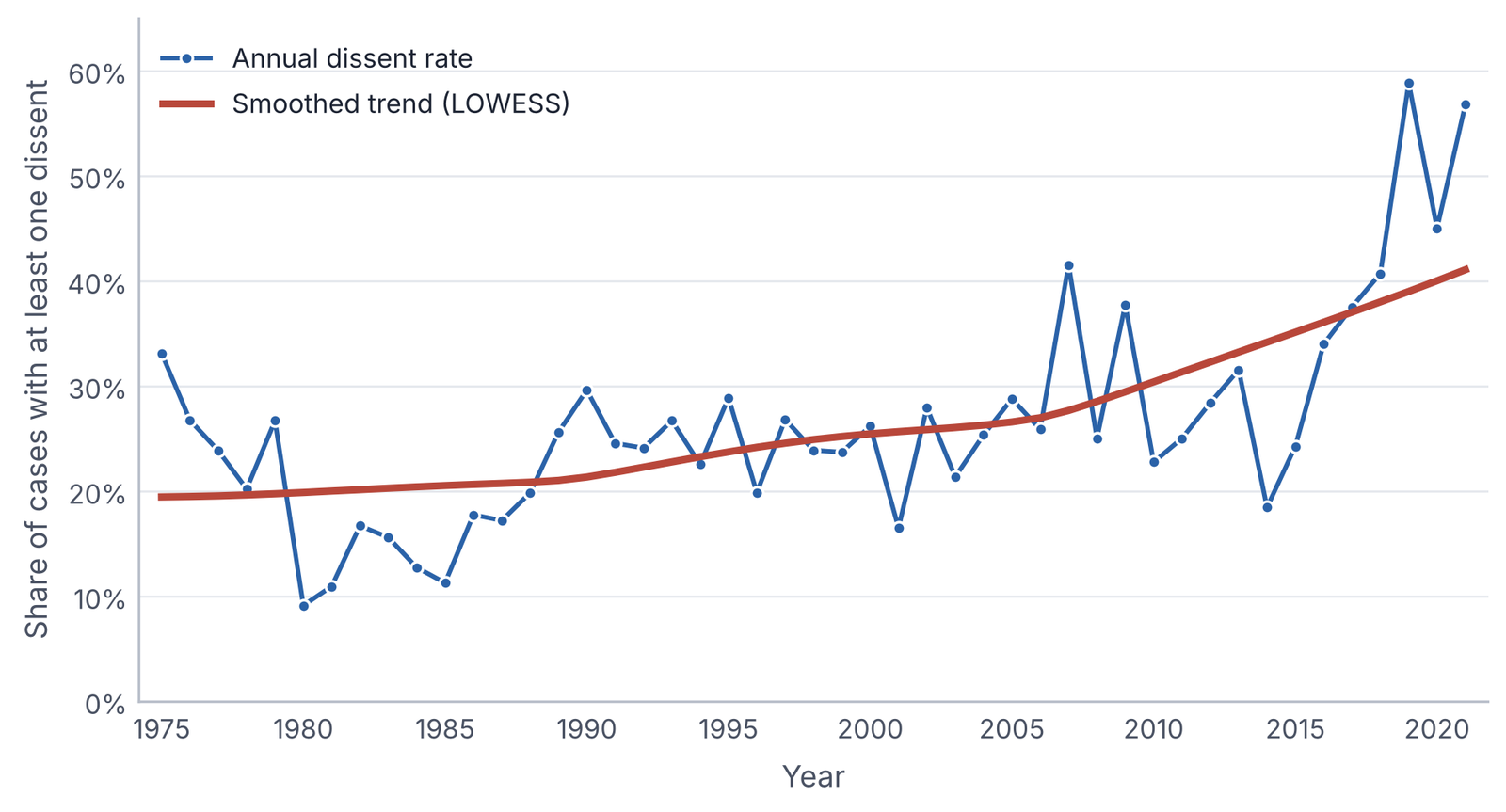
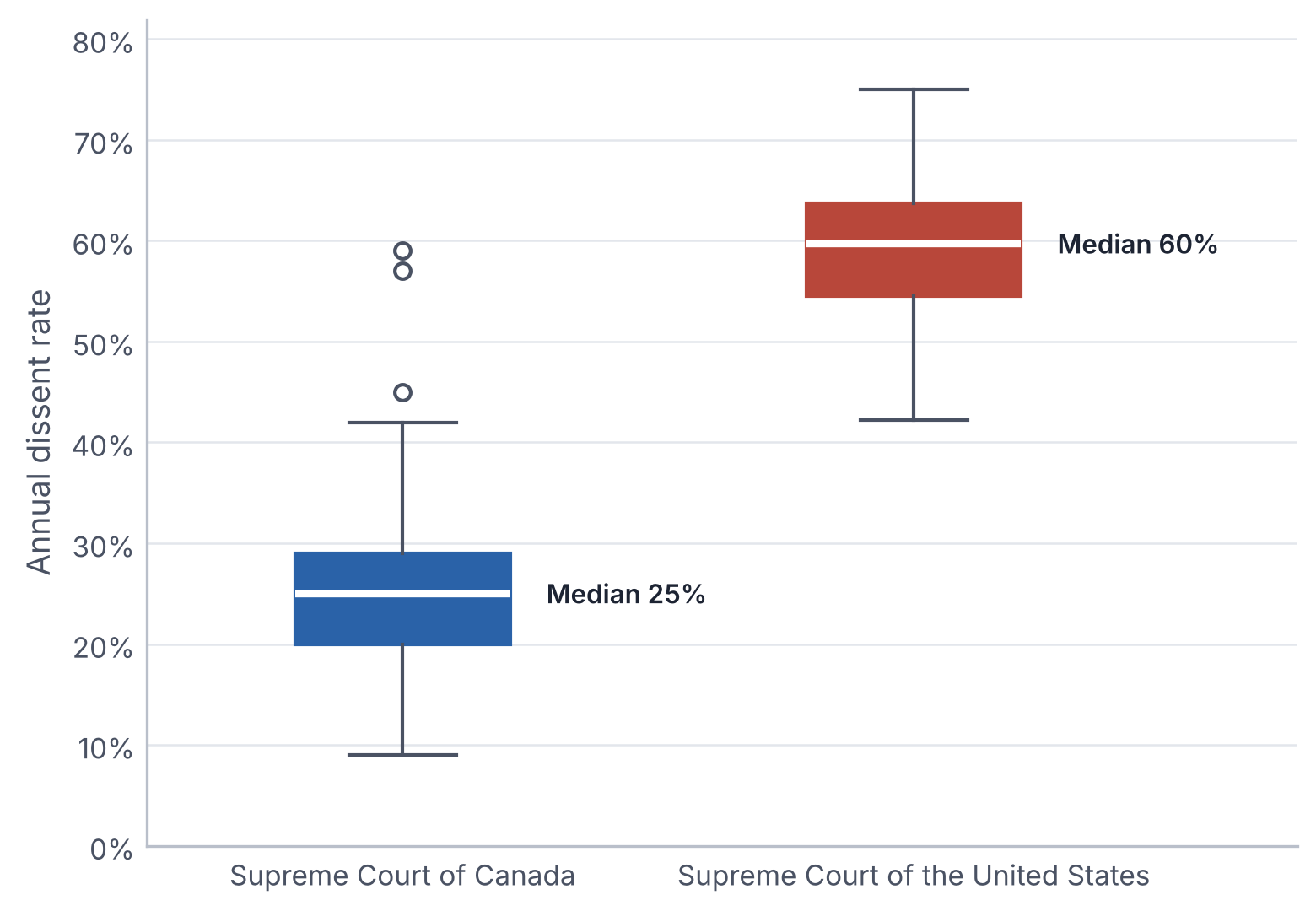
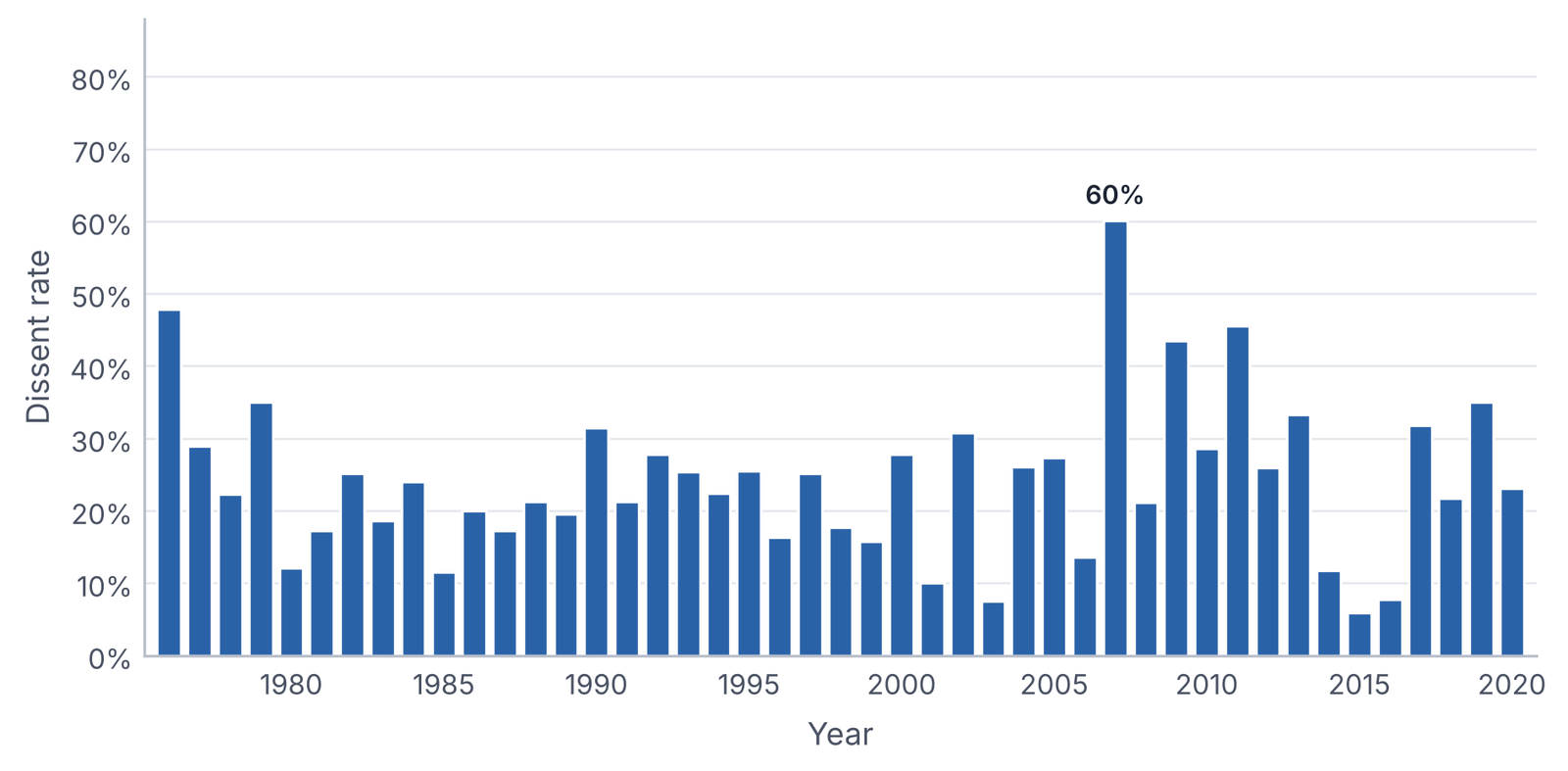
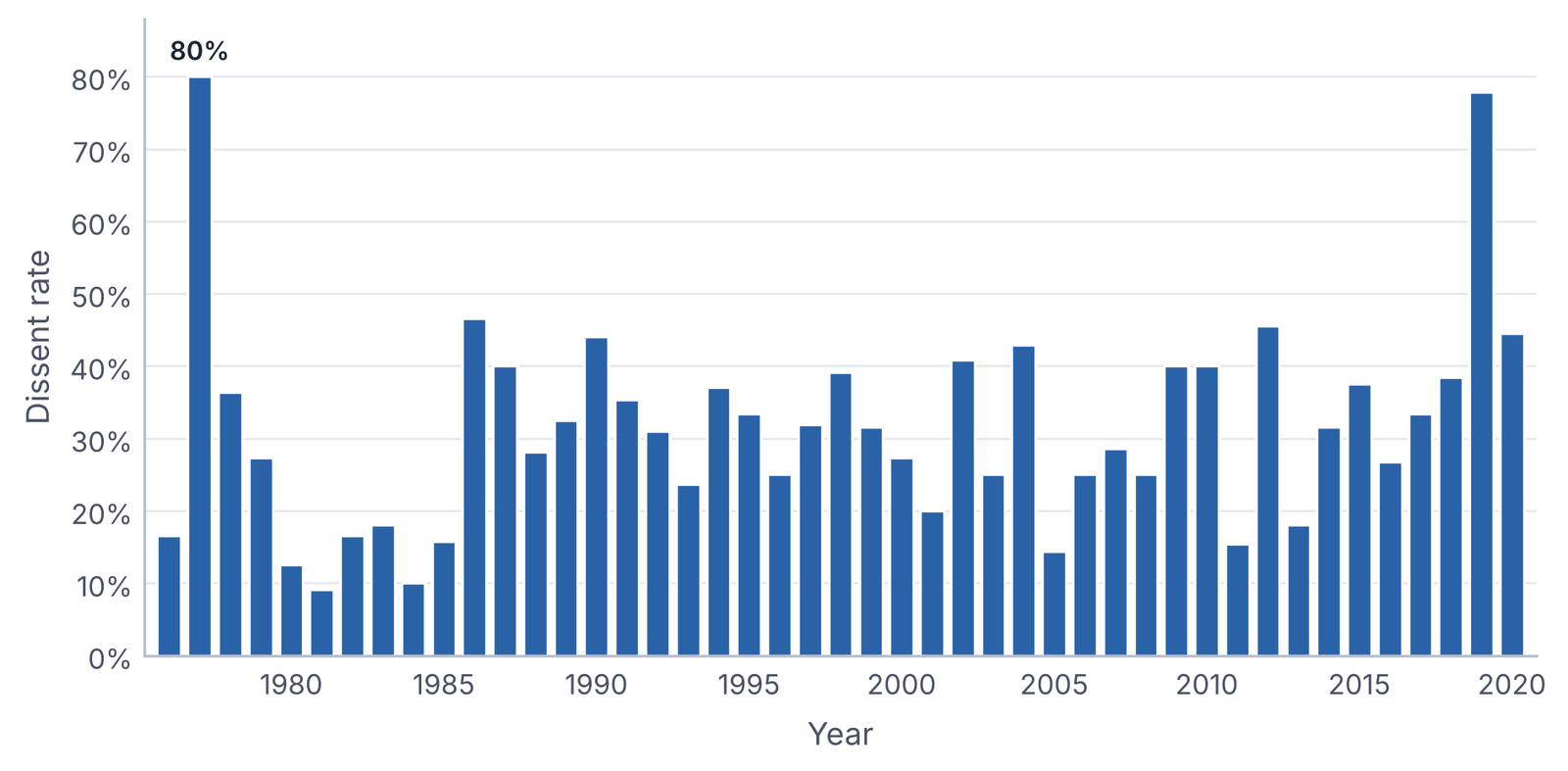
As shown in Figures 1 and 3, the SCC has experienced a significant increase in the rate at which its judges dissent. While the dissent rate hovered between 10% and 20% in the 1980s, it has increased sharply since the 2000s, falling below 20% on only two occasions (2001 and 2014) and reaching its maximum value of almost 60% in 2019. This stands in contrast to the Supreme Court of the United States (SCOTUS), where, as shown in Figure 2, the rate has always been well above 40% and has reached as high as 80% in some years. Figure 4 compares the two courts using boxplots. Together, these graphs show that the dissent rate at the SCC has risen sharply from a very low rate of 10% in the 1980s to levels similar to those at the SCOTUS by 2019.
2.Overall dissent rate trend by area of law
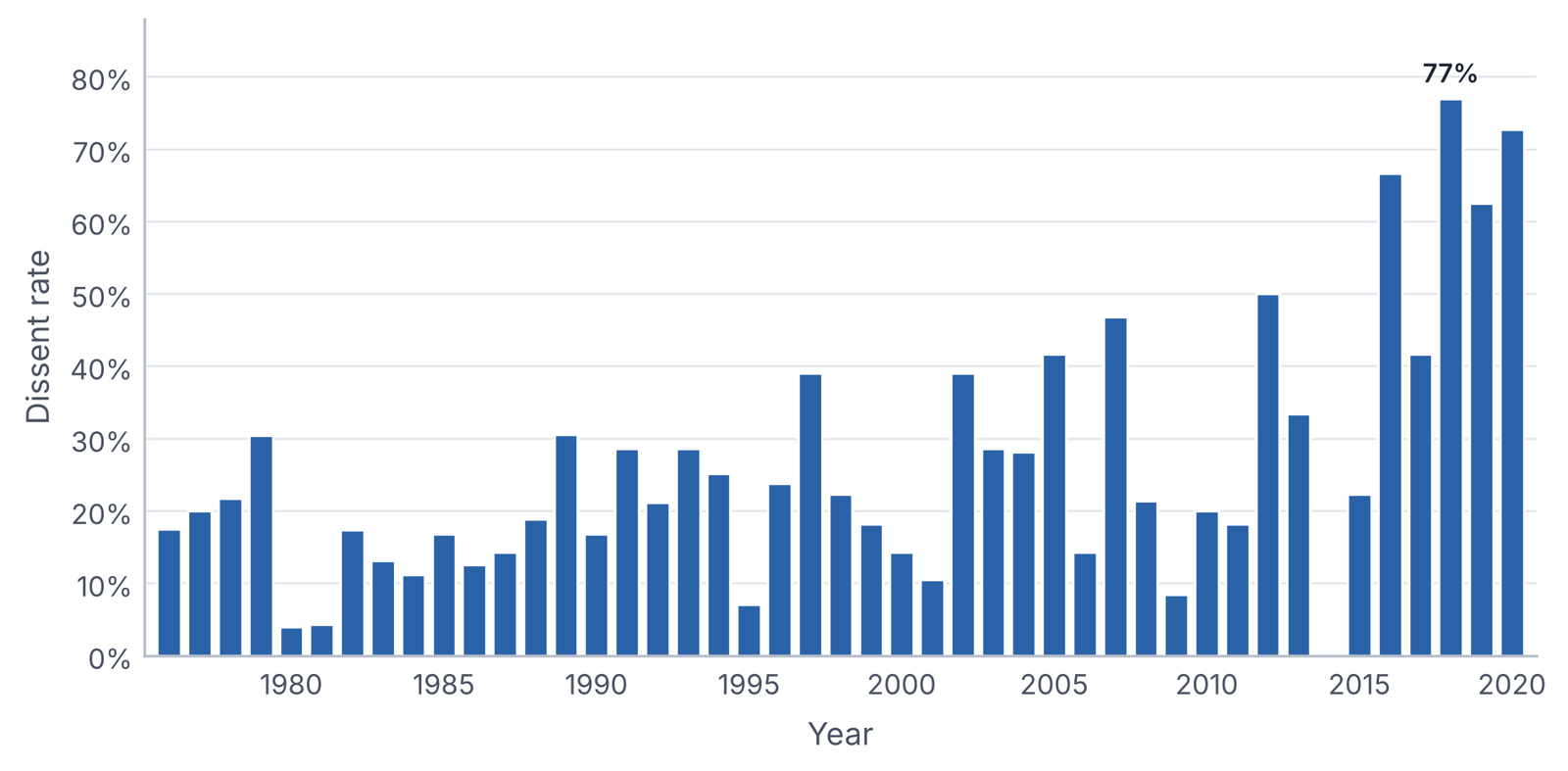
While the overall dissent rate at the SCC provides a general overview of disagreement among judges over the years, it offers little insight into the areas in which judges disagree the most. It is therefore useful to separate the areas of law and compare the dissent rate in each. Figures 5, 6, and 7 illustrate the dissent rate in criminal, constitutional, and private cases, respectively. These figures indicate that the dissent rate in criminal and constitutional cases has been fairly consistent. What is striking, however, is the significant increase in the dissent rate in private cases, which has risen sharply from the 1980s to the present, going from below 10% to above 70%.
3.Individual dissent rate among judges
To gain further insight into judicial dissenting behaviour at the SCC, it is also useful to assess the dissenting behaviour of individual judges. Table 1 lists the top 25 dissenters at the SCC, including each judge’s total number of dissents and overall dissent rate, as well as their dissent rates during the different Chief Justice eras and across areas of law. The dissent rate for each judge is calculated by dividing the number of cases in which the judge dissented by the total number of cases in which the judge sat on the bench. As the table indicates, while the greatest number of dissents belongs to Justice L’Heureux-Dubé, which may be explained by her long tenure at the Court, the highest dissent rate among SCC judges belongs to Justice Côté, at approximately 27%. In other words, Justice Côté has dissented in about one in every four cases in which she has sat on the bench. More notably, while Justice Côté’s dissent rates in criminal and constitutional cases are similar to, and in some instances lower than, those of other judges, her dissent rate in private law cases is by far the highest of any judge who has ever sat on the bench. This may be explained by the fact that she studied civil law and that her main area of practice was civil litigation.12
| Judge | Dissents | Overall rate | Dissent rate by Chief Justice era | Dissent rate by area of law | ||||||
|---|---|---|---|---|---|---|---|---|---|---|
| Wagner | McLachlin | Lamer | Dickson | Laskin | Criminal | Constitutional | Private | |||
| Côté | 81 | 0.269 | 0.255 | 0.281 | 0.11 | 0.23 | 0.34 | |||
| Rowe | 38 | 0.177 | 0.183 | 0.164 | 0.08 | 0.21 | 0.33 | |||
| Spence | 72 | 0.168 | 0.168 | 0.28 | 0.21 | 0.13 | ||||
| Brown | 42 | 0.157 | 0.167 | 0.145 | 0.07 | 0.20 | 0.17 | |||
| L’Heureux-Dubé | 170 | 0.140 | 0.144 | 0.137 | 0.147 | 0.15 | 0.18 | 0.09 | ||
| Laskin | 90 | 0.133 | 0.000 | 0.134 | 0.23 | 0.17 | 0.10 | |||
| de Grandpré | 36 | 0.130 | 0.130 | 0.07 | 0.38 | 0.16 | ||||
| Fish | 76 | 0.126 | 0.126 | 0.17 | 0.13 | 0.09 | ||||
| Kasirer | 8 | 0.113 | 0.113 | 0.10 | 0.13 | 0.15 | ||||
| Abella | 97 | 0.106 | 0.123 | 0.103 | 0.07 | 0.12 | 0.12 | |||
| Deschamps | 65 | 0.105 | 0.105 | 0.10 | 0.14 | 0.10 | ||||
| Wilson | 69 | 0.103 | 0.000 | 0.108 | 0.089 | 0.11 | 0.16 | 0.07 | ||
| Bastarache | 70 | 0.098 | 0.111 | 0.057 | 0.10 | 0.08 | 0.09 | |||
| LeBel | 89 | 0.097 | 0.097 | 0.000 | 0.08 | 0.13 | 0.10 | |||
| McLachlin | 167 | 0.084 | 0.000 | 0.063 | 0.108 | 0.101 | 0.08 | 0.10 | 0.08 | |
| Sopinka | 72 | 0.080 | 0.076 | 0.095 | 0.08 | 0.08 | 0.12 | |||
| Major | 79 | 0.079 | 0.063 | 0.089 | 0.07 | 0.08 | 0.06 | |||
| Binnie | 69 | 0.078 | 0.083 | 0.048 | 0.07 | 0.11 | 0.05 | |||
| Judson | 23 | 0.076 | 0.076 | 0.07 | 0.20 | 0.08 | ||||
| Rothstein | 40 | 0.074 | 0.074 | 0.08 | 0.07 | 0.08 | ||||
| Martin | 10 | 0.072 | 0.072 | 0.000 | 0.02 | 0.06 | 0.03 | |||
| Cromwell | 31 | 0.071 | 0.071 | 0.10 | 0.08 | 0.06 | ||||
| Arbour | 23 | 0.069 | 0.067 | 0.100 | 0.07 | 0.12 | 0.08 | |||
| Dickson | 91 | 0.068 | 0.049 | 0.076 | 0.10 | 0.06 | 0.05 | |||
| Wagner | 30 | 0.068 | 0.101 | 0.053 | 0.06 | 0.09 | 0.07 | |||
IV.Theories About Why Judges Dissent: What Affects Dissenting Behaviour
Discussions of whether judges should dissent, while valuable, do not explain why the phenomenon of dissent exists. There has been a great deal of discussion about when judges dissent, though it may be argued that this is not the right question to ask. As Peter McCormick explains, “[i]t is not very helpful to ask ‘when do judges dissent?’ because the answer is simply ‘when they think the majority got it wrong.’ The more useful question, then, is ‘in what circumstances are judges more likely to dissent?’” That is to say, given the costs associated with disagreeing with the majority, what causes judges to believe that the reward for writing a dissenting opinion outweighs those costs? Many factors could influence the likelihood of a case receiving a dissenting opinion. This section examines some of the theories of dissent and explores their effect at the SCC using data visualizations.
1.Caseload
One of the factors that scholars have argued may affect the dissent rate at a high court is caseload. Epstein, Landes, and Posner argue that as the number of cases a court hears decreases, judges tend to feel more comfortable dissenting; in other words, caseload influences the opportunity and effort costs of dissenting. The effort cost of writing a dissent is higher when the court hears more cases, which means that judges dealing with a lighter caseload have more time to elaborate their thoughts and write a dissenting opinion than panels dealing with a much heavier caseload.13 It is therefore expected that, “other things being equal, dissents will be less frequent the heavier a court’s caseload.” Epstein, Landes, and Posner offer the difference between the dissent rates of the US Courts of Appeals and the US Supreme Court as an example. According to their findings, a Supreme Court Justice writes only 8 to 10 majority opinions a year, whereas a court of appeals judge writes about 54 during the same period.14 As expected, the dissent rate at the court of appeals level has never exceeded 10%, whereas the dissent rate at the US Supreme Court is well above 60%.
i. Is the effect of caseload visible at the SCC?
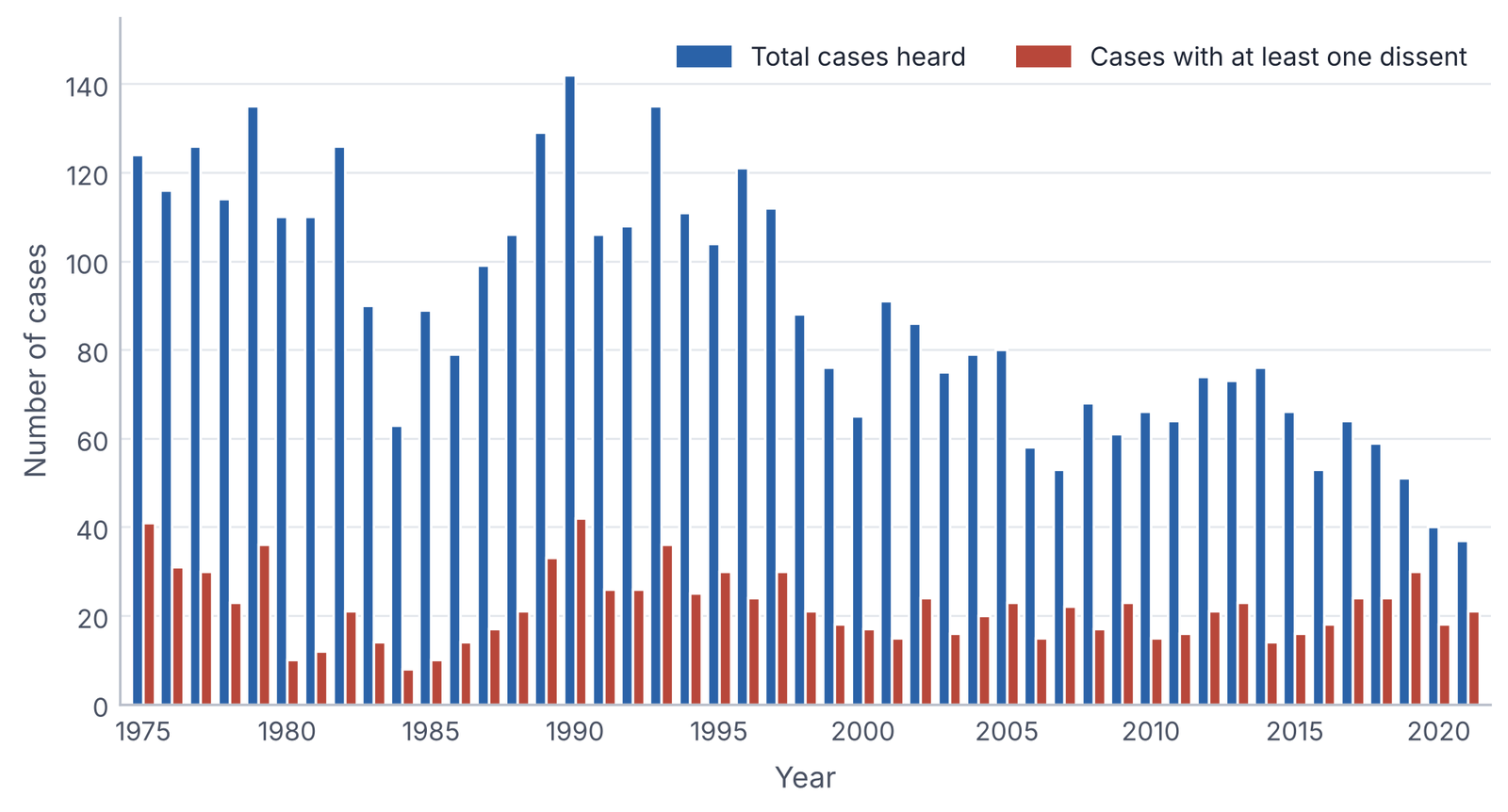
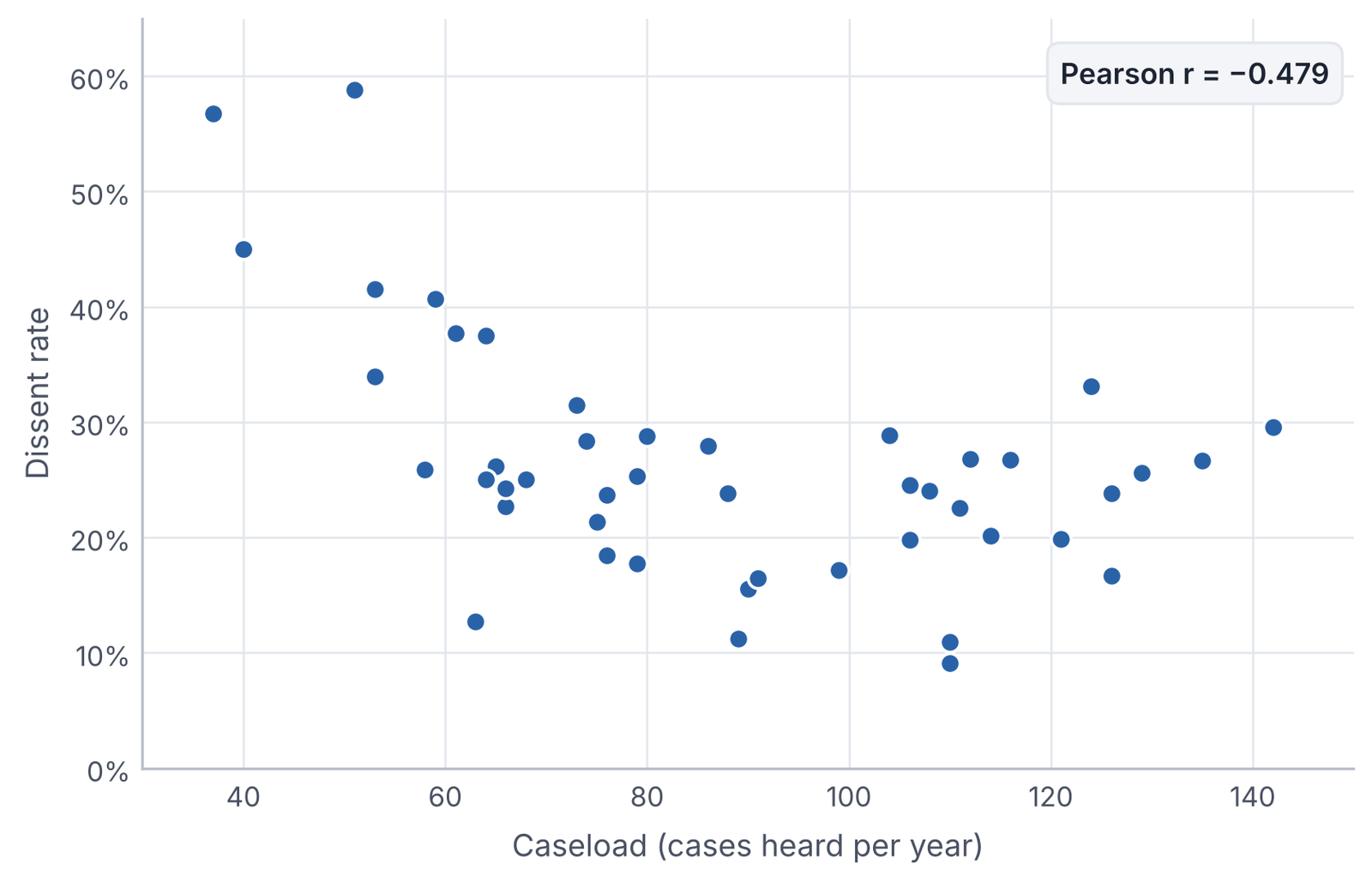
Empirical analysis of the SCC’s dissenting behaviour indicates that caseload does have a negative effect on the rate of dissent at the Court. Figure 8 presents a bar plot of the number of cases the SCC heard each year (blue bars) and the number of cases in which there was at least one dissent (red bars). The figure shows that while the number of cases heard by the SCC decreased drastically from 1975 to 2021, the number of dissents remained fairly similar. If caseload had no effect on dissents, one would expect the number of dissents to decrease over the same period. This indicates that as the number of cases has decreased, the dissent rate at the SCC has increased. Figure 9 presents a scatterplot with caseload on the x-axis and the corresponding dissent rate on the y-axis. This scatterplot clearly shows a general decrease in the dissent rate as caseload increases. The Pearson method can also be used to calculate the correlation coefficient between caseload and the dissent rate. This method produces a value between −1 and 1, where negative values indicate a negative correlation between the data sets, positive values indicate a positive correlation, and a value of 0 indicates no correlation. Applying the Pearson method yields a correlation coefficient of −0.479, which points to a negative correlation between caseload and the dissent rate. Therefore, as Epstein, Landes, and Posner predicted, the negative correlation between caseload and the dissent rate is also visible at the SCC.
2.Party lines and ideology
There is a widely held view of judicial behaviour, known as the “attitudinal model,” which posits that judges tend to decide matters not on the basis of the law but on the basis of what they believe the correct law to be.15 In other words, judges tend to produce outcomes that coincide with their ideological preferences, especially when they sit on the country’s highest court and their decisions cannot be reversed by a higher court.16 One of the factors included in the attitudinal model is party affiliation: in a politicized high court, judges tend to vote in line with their party affiliation, as they believe their party’s ideology to be the correct one. This is very apparent at the US Supreme Court, where judges consistently vote along party lines, meaning that conservative judges, almost all of whom were chosen by Republicans, tend to vote differently from liberal judges, who were mostly chosen by Democrats.
There are several ways to measure the effect of party affiliation within a court. Alarie and Green explain that “[w]e can measure how politicized a court is in many ways such as by whether judges vote in cases according to the politics of who appointed them, by how conservative ... or by how conservatively or liberally they vote relative to other judges over the course of their careers.”
Such an assessment is difficult in Canada for several reasons. First, it is difficult to define, based solely on data, what it means to be a conservative or a liberal judge in Canada, because, unlike in the United States, the assumption that liberal judges are chosen by Liberal governments and conservative judges are nominated by Conservative governments does not hold entirely true. For example, while an issue such as abortion would today almost certainly divide the US Supreme Court along party lines, as it did in Dobbs,17 the Canadian equivalent of Dobbs, R v Morgentaler, received two dissents: one from Justice La Forest, who was nominated by the Conservative Party, and one from Justice McIntyre, who was nominated by the Liberal Party. Indeed, while the US Supreme Court appears to divide along ideological lines, and consequently along the lines of the appointing party, on every controversial issue, the last time the SCC decided a case along party lines was in 2013, in La Souveraine, Compagnie d’assurance générale,18 in which the three Liberal-appointed justices, Justices Abella, LeBel, and Fish, joined together in dissent. What is surprising is that the data shows only ten occasions since 1976 on which a case at the SCC was decided along party lines. Second, it is very difficult to establish ideology at the SCC on the basis of the appointing party. Take Justice Karakatsanis, for example: although she was nominated to the SCC by the Conservative Harper government, her ideology, according to the data, appears to align very well with that of Justice Abella, a very liberal judge nominated by the Liberal government. This is evident from her dissenting opinions in cases such as R v Fearon,19 in which she wrote, for herself, Justice Abella, and Justice LeBel, on the importance of privacy in the context of warrantless search and seizure. Finally, the effect of the appointing party on ideology is difficult to assess at the SCC because of the highly variable composition of the Court. While the composition of the US Supreme Court has not fallen below a 6–3 majority–minority split by appointing party from 1976 to the present, the SCC has gone through extreme periods of having seven Liberal-appointed justices (1977–1979, 1983–1989, and late 2004–2009) or eight Conservative-appointed justices (1991–1997 and 2015 to the beginning of 2017).
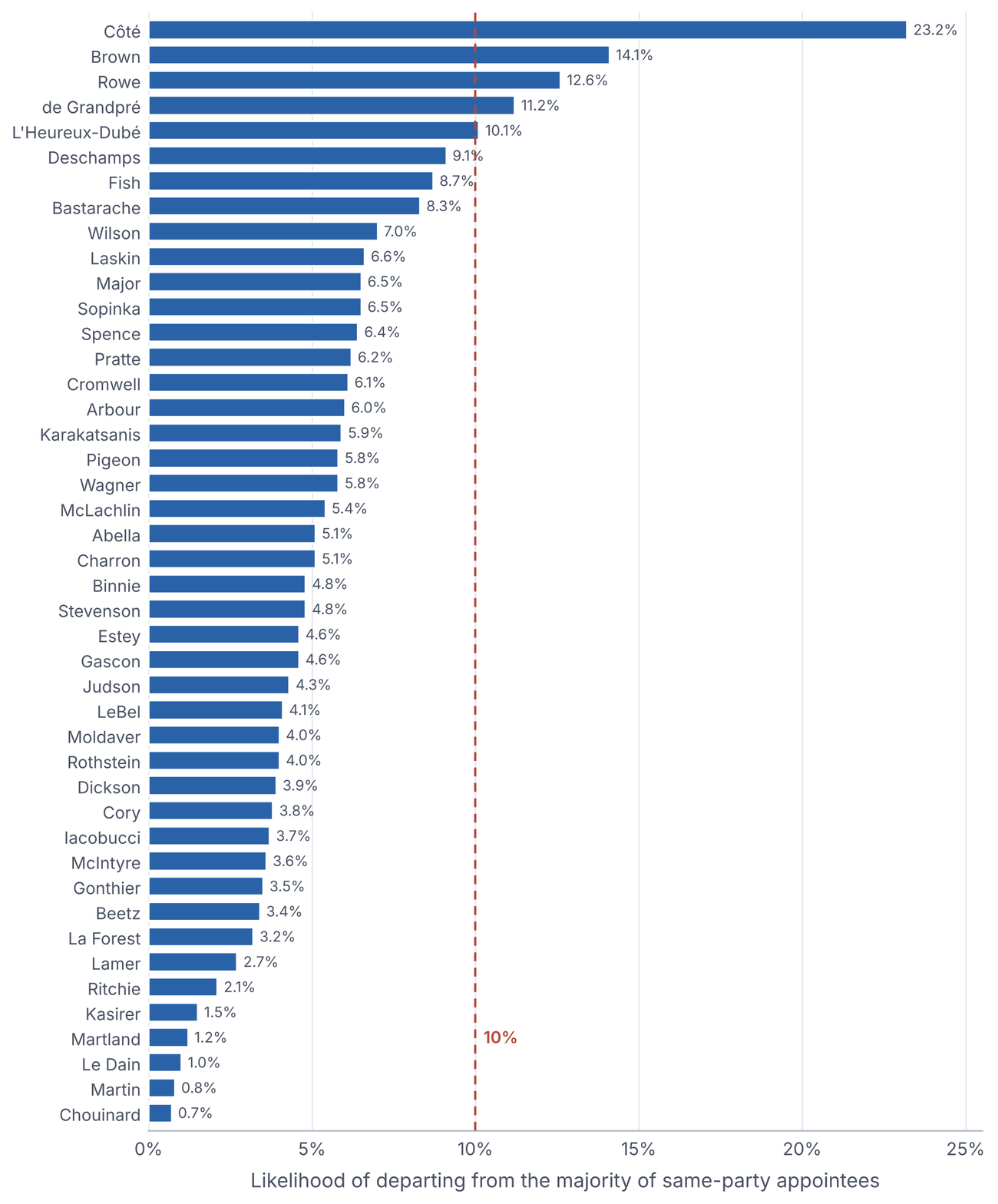
All of these reasons indicate that the ideologies of SCC judges do not depend on the party that nominated them to the Court. However, does this mean that the appointing party has no effect on how judges dissent? Table 2 helps answer this question. It shows each judge’s tendency to depart from the majority decision of the judges appointed by the same party. In other words, the table counts the number of times each judge was on the opposite side of the argument from the majority of the judges appointed by that party. For example, in a court of six Liberal and three Conservative appointees, if a Liberal-appointed judge dissents in a case in which at least four Liberal-appointed judges were in the majority, that judge is deemed to have departed from their party’s decision. In the same case, if a judge appointed by a Conservative government joins the majority opinion while the other two Conservative-appointed judges have joined the dissent, that judge is likewise considered to have departed from his or her party’s ideology. Figure 10 presents this information as a bar plot. Table 2 and Figure 10 show that, with the exception of Justices Côté, Brown, Rowe, and de Grandpré, SCC judges depart from their party’s opinion less than 10% of the time. Although no point of comparison could be found for other high courts, such as the SCOTUS, it can safely be assumed that SCC judges have a strong tendency to vote with the judges appointed by the same party. What does this mean for the effect of the appointing party on SCC judges? Judging by the data provided in this section, it can be said that, while judges tend to side with their colleagues appointed by the same party, this agreement almost never reaches the point of unanimity. In most cases, there is at least one judge, and usually only one, who departs from their party’s ideology. This explains the low number of party-line decisions while also explaining the low likelihood of departure.
| Judge | Stayed with party | Departed | Likelihood of departure |
|---|---|---|---|
| Côté | 222 | 67 | 0.232 |
| Brown | 219 | 36 | 0.141 |
| Rowe | 166 | 24 | 0.126 |
| de Grandpré | 213 | 27 | 0.112 |
| L’Heureux-Dubé | 1,038 | 116 | 0.101 |
| Deschamps | 538 | 54 | 0.091 |
| Fish | 527 | 50 | 0.087 |
| Bastarache | 627 | 57 | 0.083 |
| Wilson | 609 | 46 | 0.070 |
| Laskin | 595 | 42 | 0.066 |
| Major | 902 | 63 | 0.065 |
| Sopinka | 805 | 56 | 0.065 |
| Spence | 365 | 25 | 0.064 |
| Pratte | 181 | 12 | 0.062 |
| Cromwell | 403 | 26 | 0.061 |
| Arbour | 296 | 19 | 0.060 |
| Karakatsanis | 463 | 29 | 0.059 |
| Pigeon | 489 | 30 | 0.058 |
| Wagner | 404 | 25 | 0.058 |
| McLachlin | 1,814 | 104 | 0.054 |
| Abella | 818 | 44 | 0.051 |
| Charron | 388 | 21 | 0.051 |
| Binnie | 813 | 41 | 0.048 |
| Stevenson | 120 | 6 | 0.048 |
| Estey | 774 | 37 | 0.046 |
| Gascon | 229 | 11 | 0.046 |
| Judson | 288 | 13 | 0.043 |
| LeBel | 836 | 36 | 0.041 |
| Moldaver | 477 | 20 | 0.040 |
| Rothstein | 500 | 21 | 0.040 |
| Dickson | 1,247 | 50 | 0.039 |
| Cory | 894 | 35 | 0.038 |
| Iacobucci | 1,027 | 39 | 0.037 |
| McIntyre | 808 | 30 | 0.036 |
| Gonthier | 1,145 | 41 | 0.035 |
| Beetz | 1,059 | 37 | 0.034 |
| La Forest | 973 | 32 | 0.032 |
| Lamer | 1,320 | 36 | 0.027 |
| Ritchie | 788 | 17 | 0.021 |
| Kasirer | 65 | 1 | 0.015 |
| Martland | 651 | 8 | 0.012 |
| Le Dain | 303 | 3 | 0.010 |
| Martin | 132 | 1 | 0.008 |
| Chouinard | 535 | 4 | 0.007 |
3.Number of judges sitting on the case
Another factor said to affect the dissent rate of a high court is the number of judges sitting on the case. The theory, as Epstein, Landes, and Posner argue, is that as the number of judges sitting on a panel grows, the rate of dissent increases.20 This is another reason why the dissent rate of the US Courts of Appeals is significantly lower than that of the SCOTUS. The phenomenon can be explained by the fact that when the number of judges sitting together on a panel is low, factors such as collegiality tend to be more dominant, affecting a judge’s willingness to dissent.21 Furthermore, the greater the likelihood that several judges, rather than just one, will dissent, the lower the cost of dissenting, because a dissenting judge may be pleasing other judges, namely the fellow dissenters, by expressing disagreement.
i. Is the effect of the number of judges on the panel visible at the SCC?
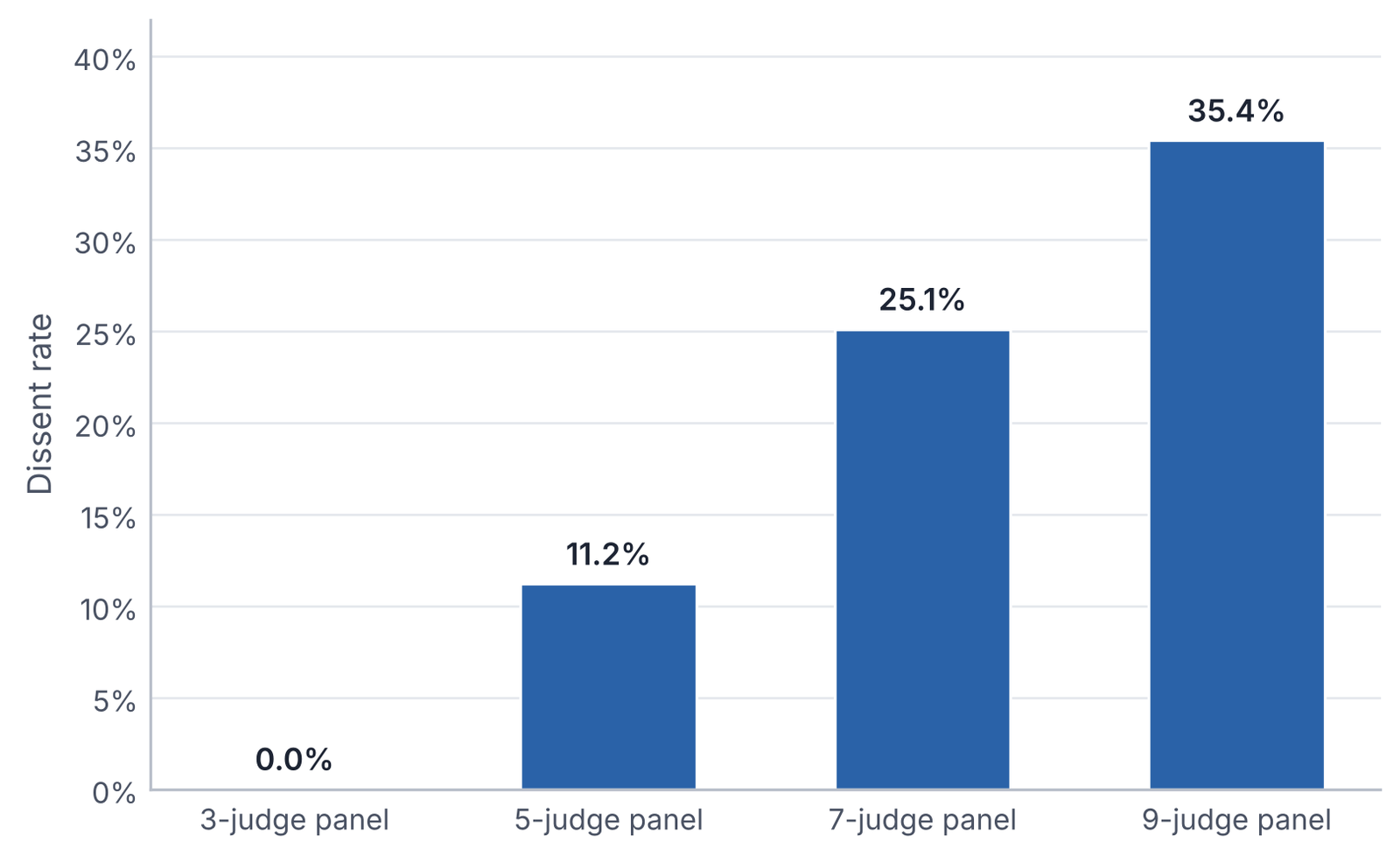
There is strong evidence to suggest that the theory on the relationship between the number of judges on a panel and the rate of dissent applies to the SCC. To evaluate this, the SCC data was divided into four categories based on the number of judges sitting on the panel: 3-person, 5-person, 7-person, and 9-person panels. Each category was then evaluated based on the number of cases with at least one dissenter. As shown in Figure 11, the dissent rate at the SCC increases significantly as the number of judges on a panel grows. While cases heard by a panel of three judges had no dissents, the 5-person, 7-person, and 9-person panels had dissent rates of 11.2%, 25.1%, and 35.4%, respectively. It can therefore safely be said that the dissent rate at the SCC is clearly positively related to the number of judges hearing the case.
4.The effect of Chief Justices
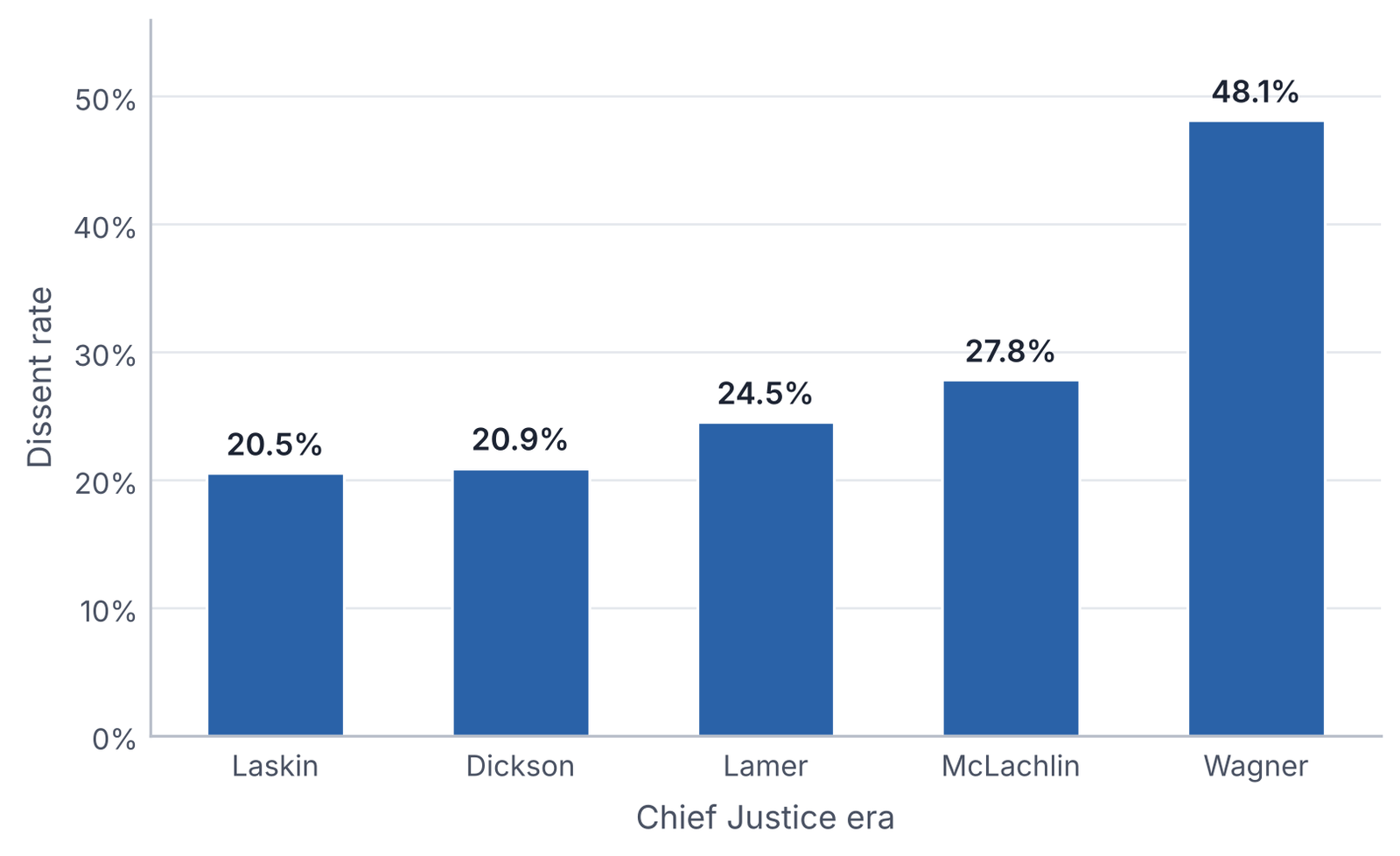
There is an assumption that Chief Justices can have a significant effect on the level of disagreement in high courts. Chief Justice McLachlin, for example, made increasing consensus at the SCC one of her key goals.22 One may then ask whether, given her priority of reducing disagreement and promoting unanimity, Chief Justice McLachlin succeeded in achieving her goal. Figure 12 shows the dissent rate in each Chief Justice’s era. The figure shows that the lowest dissent rate belongs to the Laskin era, at only 20.5%, followed by the Dickson, Lamer, McLachlin, and Wagner eras, at 20.9%, 24.5%, 27.8%, and 48.1%, respectively.
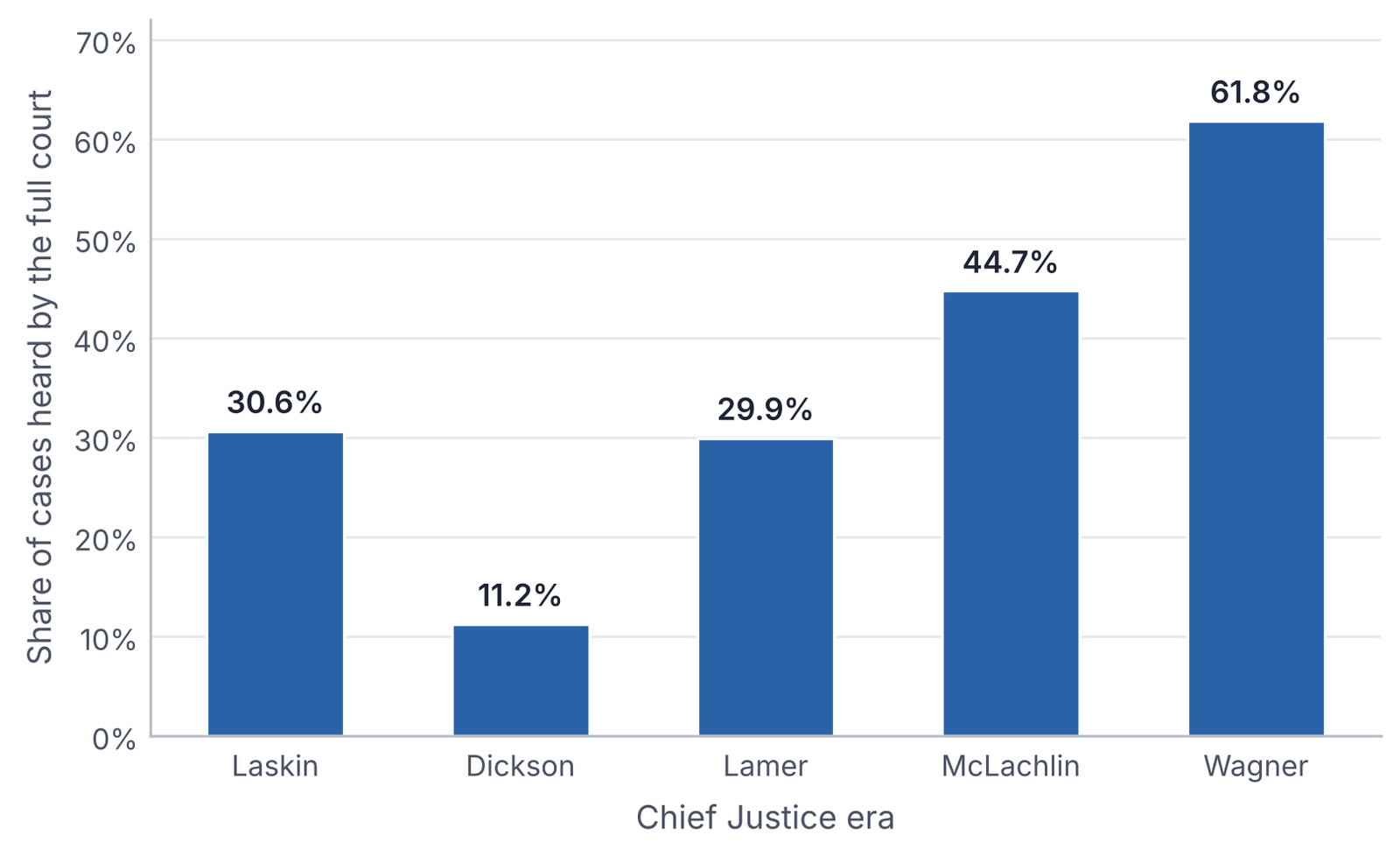
Does this mean that Chief Justice McLachlin was unsuccessful in her efforts to unify the Court? And does it mean that Chief Justices have no effect on the dissent rate at high courts? To better understand Chief Justice McLachlin’s success, one must also consider the other factors that affect the dissent rate. For example, as noted above, the dissent rate tends to increase significantly as the number of judges on a panel increases. Figure 13 shows the percentage of cases heard by a full panel in each Chief Justice’s era. The figure shows that Chief Justices McLachlin and Wagner selected a full 9-judge court in a significantly larger share of cases (44.7% and 61.8% of cases, respectively) than Chief Justices Lamer, Dickson, and Laskin, who did so significantly less frequently (29.9%, 11.2%, and 30.6%, respectively). The higher percentage of full-court panels may very well have increased the dissent rate in the McLachlin era and may also explain the particularly high dissent rate during the Wagner era. Therefore, taking these other external factors into account, one can conclude that Chief Justice McLachlin fairly succeeded in achieving greater unanimity and consensus within the SCC compared with her predecessors.
5.Effect of gender
Scholars have attempted to evaluate whether female judges dissent more frequently than male judges. Some studies have pointed out that female judges at the SCC tend to dissent more frequently in criminal, civil liberties, sexual assault, and equality cases.23 Studies have also shown that women tend to dissent much more freely when joined by other women and are less willing to compromise when present in larger numbers.24 But does this effect extend to the cases the SCC hears in general?
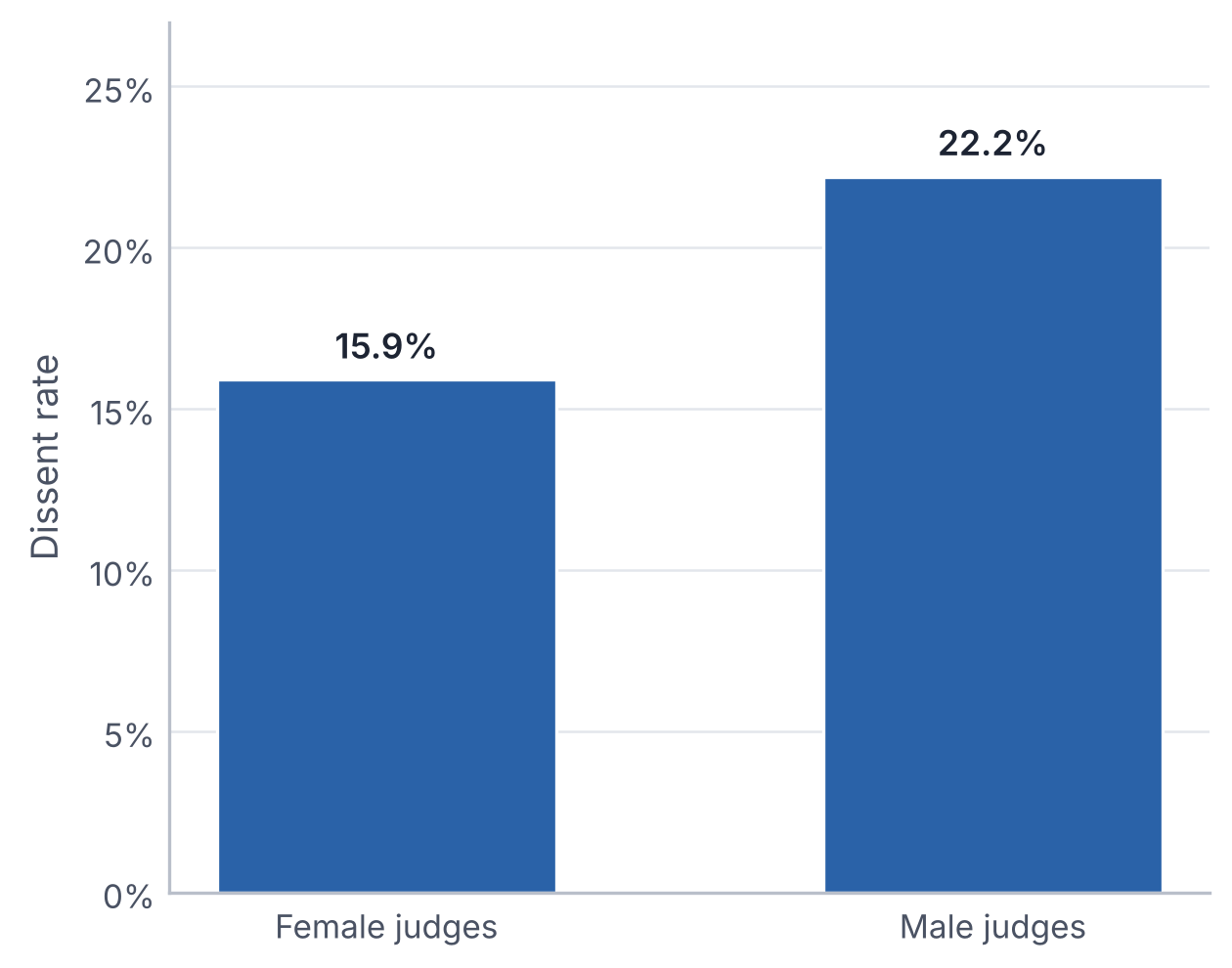
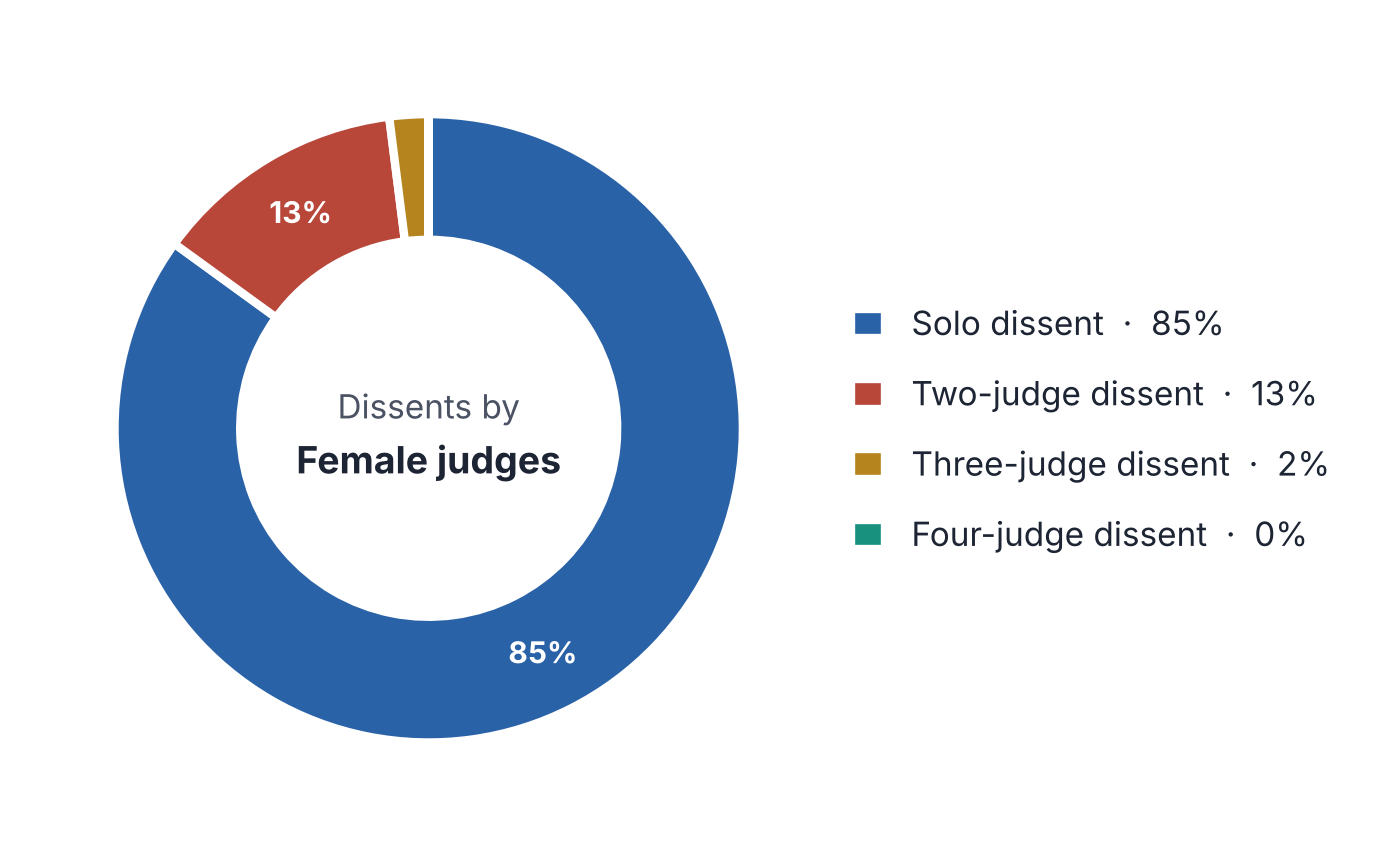
The findings of this paper run contrary to these arguments. For example, as shown in Figure 14, while female judges dissent at a rate of about 16%, male judges dissent at a higher rate of 22.2%, which indicates that male judges at the SCC have a greater tendency to dissent. Furthermore, the argument that female judges tend to join dissents when other female judges are in the dissent also does not hold true. As shown in Figure 15, female judges have dissented alone significantly more often than together with other female judges. In fact, the SCC has never heard a case in which all four female judges joined together in a dissenting opinion. Moreover, as shown in Table 2, while some female judges, such as Justices Côté and L’Heureux-Dubé, have a rather high dissent frequency, others, such as Justices Abella, McLachlin, and Karakatsanis, do not even rank in the top 15. Therefore, there does not appear to be a statistically significant difference in dissenting patterns between male and female judges, nor does there appear to be support for the claim that female judges write dissents more frequently when joined by other female judges.
V.What Explains the Increase in the Dissent Rate at the SCC?
Whatever its causes, the increase in the dissent rate at the SCC is undeniable. The Court has gone from, on average, 15% of cases having at least one dissent in the 1980s to more than 60% in 2019. In fact, other than on two occasions, the Court has not had a dissent rate below 20% since the late 1980s. This paper has shown that neither highly politicized cases nor the more visible role of female judges has had a significant effect on this rising dissent rate. What, then, could explain this phenomenon? This section discusses some of the potential factors that may have contributed to the increase in the dissent rate at the SCC since the 1980s.
1.The arrival of the Charter
The beginning of the 1980s coincided with the arrival of the Canadian Charter of Rights and Freedoms,25 which provided Canadians with constitutional protection for their rights, such as freedom of expression and freedom of religion. During the 1980s, the SCC heard many cases dealing with the interpretation of the Charter, which could explain the sudden rise in the dissent rate from the beginning of the decade towards its end. While unanimity was still visible in most of these cases, it was clear that the Court was struggling to keep levels of disagreement down. For example, while the Court remained unanimous in cases such as Oakes, Hunter v Southam, Big M Drug Mart, and the BC Motor Vehicle Act,26 disagreements arose in many other Charter cases, such as Irwin Toy, Morgentaler, and Keegstra.27 The arrival of the Charter and the task of interpreting it may therefore have led to a higher rate of disagreement among judges at the SCC.
2.Number of full-panel hearings and lower caseloads
As discussed above, the number of judges sitting on a panel can significantly affect the dissenting behaviour of judges: the more judges on a panel, the greater the chance that disagreement will arise within it. As shown in Figure 11, the dissent rate rises sharply from 11% in 5-person panels to about 35% in 9-person panels, a significant difference. It so happens that the SCC began hearing a larger proportion of its cases with a full panel at the same time as the dissent rate increased. Chief Justices McLachlin and Wagner both decided to increase drastically the number of full-panel hearings compared with their predecessors. It cannot be a coincidence that the dissent rate at the SCC is rising simultaneously with the number of full-panel hearings. Therefore, at least a portion of the increase in the dissent rate can confidently be attributed to the sharp increase in the rate of 9-judge hearings at the SCC.
The SCC’s lower caseload is also most likely contributing to the rise in the dissent rate at the Court. Judges now have more time to deliberate on the issues and, in most cases, do not need to deliver their decisions on the same day. This leads to more potential arguments and, therefore, a higher chance of judges dissenting.
3.Technology and the arrival of more complex issues
Technological advancement is certainly bringing more issues before the SCC, and judges are faced with deciding matters of which they do not have a complete understanding. This can give rise to disagreement within the Court. Peter McCormick explains that judges tend to dissent more often “when they are dealing with new issues or with older issues that have been transformed by changing social circumstances and expectations, or when they are developing new law, or when they are attempting rigorously to complete answers to questions that have previously been handled in a more preliminary or ad hoc fashion. It is not that there is disagreement only on novel matters and never on more established matters, but rather that as a general rule, there is more disagreement on novel matters and much more limited disagreement relating to generally settled issues.”28
Since the beginning of the 21st century, the SCC has heard cases related to the use of technology. Cases such as Harvard College and Monsanto addressed the patentability of higher life forms, while others, such as CBC v SODRAC, addressed technological neutrality in copyright. These issues were certainly novel at the time and required judges to combine their legal expertise with an understanding of scientific concepts. These debates may have led to disagreement within the Court about how to apply the law to technology, which could, in turn, prompt some judges to voice their disagreement in the case. Technology can therefore also be considered a contributing factor in the rise of the dissent rate at the SCC.
4.Justice Côté’s dissenting behaviour: surpassing the “Great Dissenter”
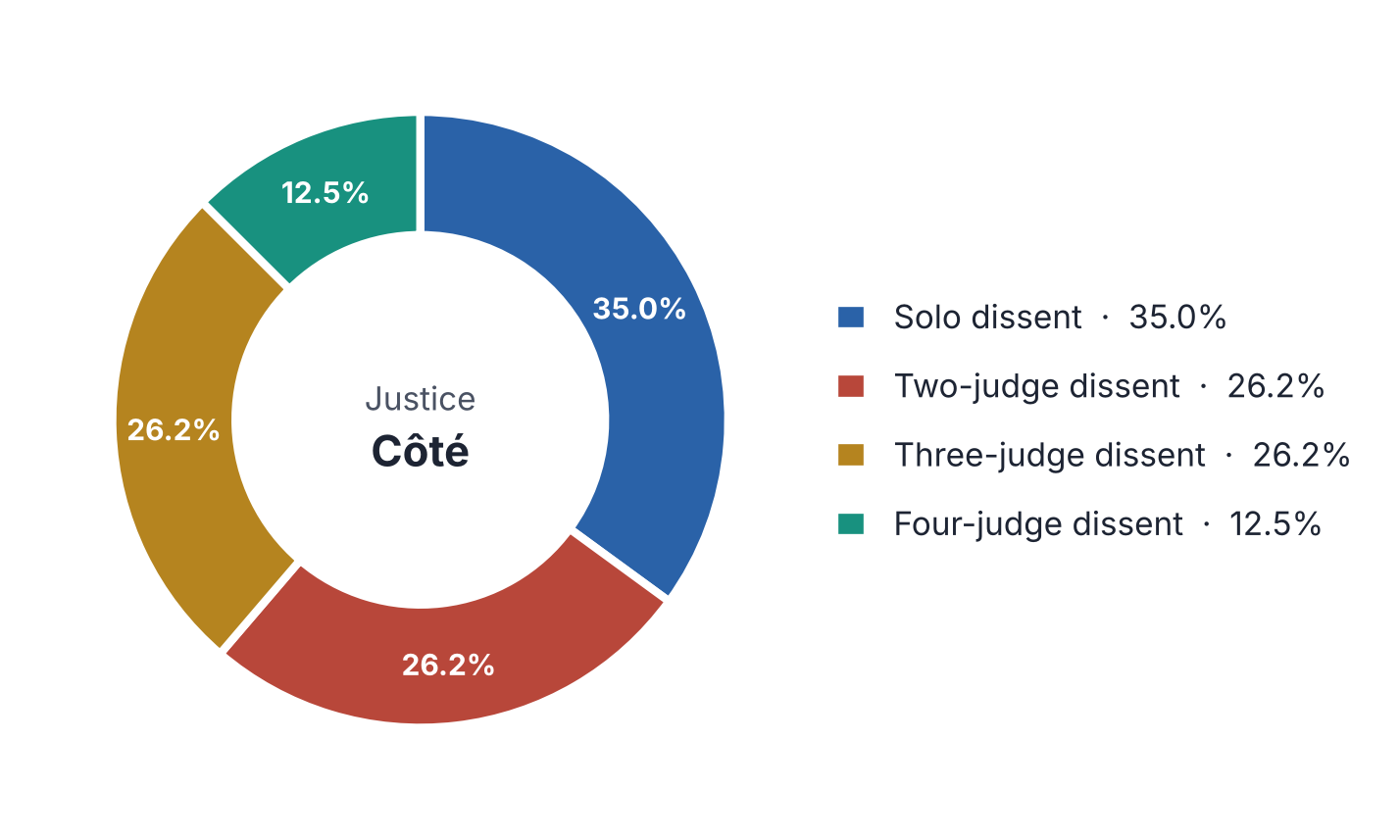
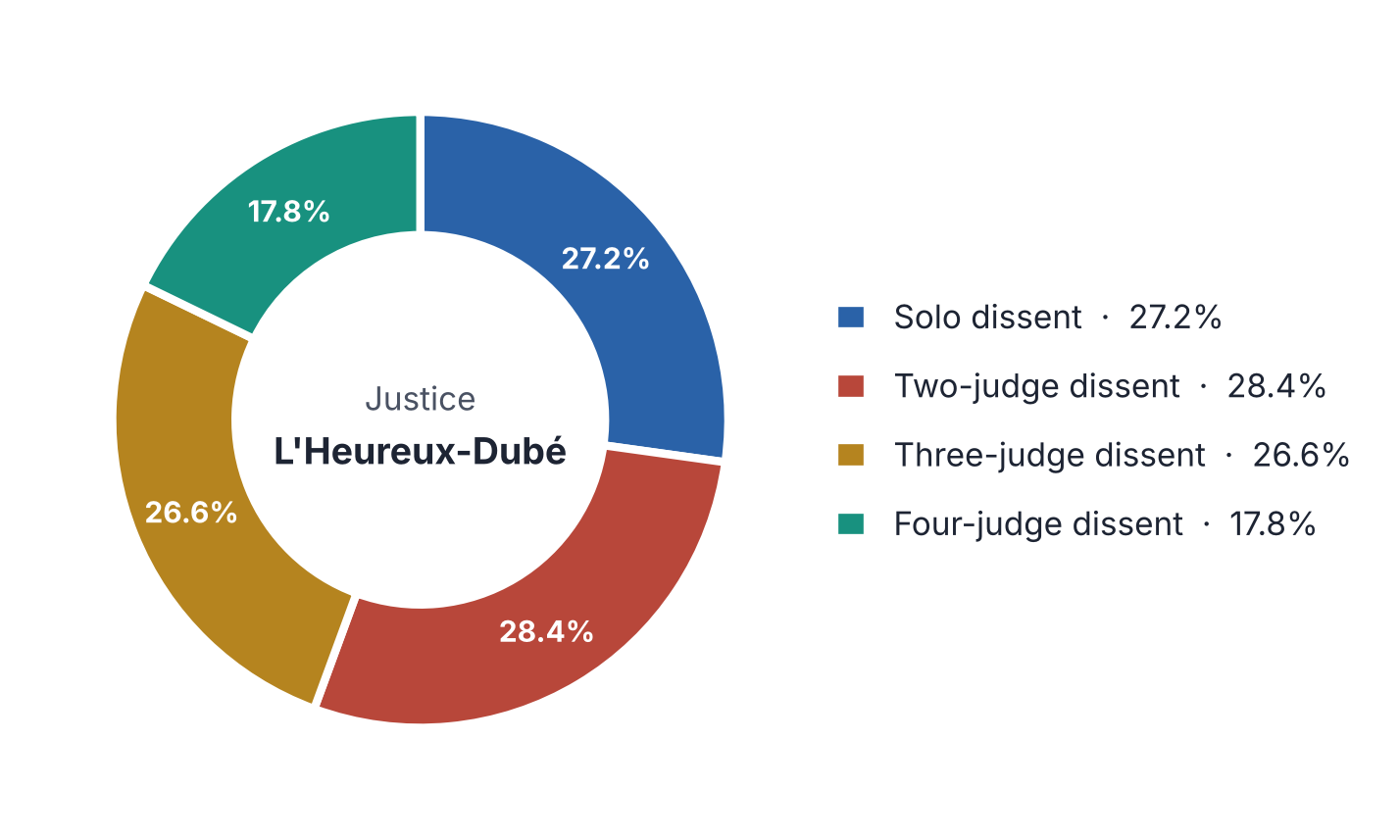
Justice L’Heureux-Dubé has long been known as the “Great Dissenter” of the SCC,29 but it appears that another Justice must now be crowned with this title: Justice Suzanne Côté. Justice Côté has dissented in an unusually high 27% of the cases in which she has sat on the bench, which translates to a little over one dissent in every four cases. Justice Côté has even dissented on ten occasions in leave applications, which is highly unusual. To put this into perspective, from 2006 to 2019, there were only 12 dissents in total on leave applications: one from Justice Binnie, one from Justice Moldaver, and ten from Justice Côté.30 According to the data, 35% of Justice Côté’s dissents have been solo dissents, surpassing the proportion for Justice L’Heureux-Dubé, who was famous for her solo dissents (Figures 16 and 17). Justice Côté tends to express her disagreement in the form of dissents rather than concurring opinions and, owing to her background as a corporate-commercial lawyer, has shown a strong tendency to disagree with the majority in civil cases, in which her dissent rate is even higher, at about 34%. Her solo dissents, together with her frequent dissents on civil matters, could partially explain the increased rate of dissent in civil cases, as shown in Figure 7, as well as the general increase in the dissent rate at the SCC.
VI.Conclusion
Analyzing the dissenting behaviour of judges is complicated. While the simple answer to “why judges dissent” may be that they disagree with the opinion of the majority, identifying what causes judges to write dissenting opinions, and determining which factors played a role in a judge’s eventual decision to dissent, is very difficult. Although it is next to impossible to predict with high accuracy whether a particular judge will dissent in a given case, certain factors have been studied and found to affect judges’ tendency to dissent. For example, the caseload of a court has been found to be inversely related to the rate of dissent in that court, and the number of judges sitting on a panel has been found to be directly correlated with higher rates of dissent. Other factors, such as the role of female judges, have also been discussed as having an effect on the dissent rate at high courts.
The goal of this paper was to study the theories about what affects a judge’s decision to dissent and to apply them to the SCC in order to determine whether any of these factors explain the sharp increase in the rate of dissent at the Court. Using data analytics on data gathered from SCC cases decided from 1976 to 2021, this paper has shown the effects of caseload and of the number of judges sitting on the panel on the dissent rate at the SCC. It has also shown that the arrival of female judges has not had a significant effect on the overall increase in the dissent rate. However, other factors, such as the Chief Justices’ tendency to assign full panels to more hearings, the arrival of the Charter, more advanced cases related to science and technology, and the unusual dissenting behaviour of judges such as Justice Côté, are contributing to the rise in the dissent rate at the SCC. In short, while there is no single perfect indicator of dissent, a combination of factors can be used to explain the dissenting behaviour at the SCC.
Notes
- Marie-Claire Belleau & Rebecca Johnson, “Judging Gender: Difference and Dissent at the Supreme Court of Canada” (2008) 15:1 Intl J of the Legal Profession 57 at 59 [Judging Gender]. ↩
- Roe v Wade, 410 US 113 (1973). ↩
- Dobbs v Jackson Women’s Health Organization, 597 US (2022) [Dobbs]. ↩
- Peter W Hogg & Ravi Amarnath, “Why Judges Should Dissent” (2017) 67:2 U of Toronto LJ 126 at 129–30 [Hogg]. ↩
- Hogg, supra note 4 at 131. ↩
- Kirk Makin, “Justice Ian Binnie’s Exit Interview” (23 September 2011), online: The Globe and Mail <https://www.theglobeandmail.com/news/national/justice-ian-binnies-exit-interview/article555452/?page=all>. ↩
- Farda M Steel, “The Role of Dissents in Appellate Judging” (2017) 67:2 U of Toronto LJ 142 at 144. ↩
- Emmet Macfarlane, “Consensus and Unanimity at the Supreme Court of Canada” (2010) 52 Supreme Court LR 379 at 401 [Macfarlane]. ↩
- Lee Epstein, William L Landes & Richard Posner, “Why (and When) Judges Dissent: A Theoretical and Empirical Analysis” (2011) 3:1 J of Legal Analysis 101 at 104 [Epstein]. ↩
- Supreme Court Act, RSC 1985, c S-26. ↩
- Donald R Songer, John Szmer & Susan W, “Explaining Dissent on the Supreme Court of Canada” (2011) 44:2 Canadian J of Political Science 389 at 399 [Songer]. ↩
- Vanessa A MacDonnell, “Justice Suzanne Côté’s Reputation as a Dissenter on the Supreme Court of Canada” (2019) 88 Osgoode Hall LR 47 at 50 [MacDonnell]. ↩
- See generally Epstein, supra note 9; Paresh Kumar Narayan & Russel Smyth, “What Explains Dissent on the High Court of Australia? An Empirical Assessment Using a Cointegration and Error Correction Approach” (2007) 4:2 J of Empirical Legal Studies 401. ↩
- Epstein, supra note 9 at 104. ↩
- Benjamin Alarie & Andrew Green, Commitment and Cooperation on High Courts: A Cross-Country Examination of Institutional Constraints on Judges (Oxford University Press, 2017) at 29 [Alarie]. ↩
- Lee Epstein, Richard Posner & William Landes, The Behavior of Federal Judges: A Theoretical and Empirical Study of Rational Choice (Cambridge: Harvard University Press, 2013) at 29 [Posner]. ↩
- Dobbs, supra note 3. ↩
- La Souveraine, Compagnie d’assurance générale v Autorité des marchés financiers, 2013 SCC 63. ↩
- R v Fearon, 2014 SCC 77. ↩
- Epstein, supra note 9 at 120. ↩
- Epstein, supra note 9 at 109. ↩
- Macfarlane, supra note 8 at 384. ↩
- Susan W Johnson & Rebecca A Reid, “Speaking Up: Women and Dissenting Behavior in the Supreme Court of Canada” (2020) 41:3 Justice System J 192. ↩
- Ibid. ↩
- Canadian Charter of Rights and Freedoms, s 7, Part I of the Constitution Act, 1982, being Schedule B to the Canada Act 1982 (UK), 1982, c 11. ↩
- R v Oakes, [1986] ACS no 7, [1986] SCJ No 7 (QL); Hunter v Southam, [1984] ACS no 36, 84 DTC 6467; R v Big M Drug Mart, [1985] ACS no 17, [1985] SCJ No 17 (QL); Re BC Motor Vehicle Act, [1985] ACS no 73, 36 MVR 240. ↩
- Irwin Toy v Quebec, [1989] ACS no 36, [1989] SCJ No 36 (QL); R v Morgentaler, [1988] ACS no 1, [1988] SCJ No 1 (QL); R v Keegstra, [1990] ACS no 131, [1990] SCJ No 131 (QL). ↩
- Peter McCormick, The End of the Charter Revolution: Looking Back from the New Normal (Toronto: University of Toronto Press, 2015) at 178. ↩
- MacDonnell, supra note 12 at 48; Stephen J Choi et al, Judging Gender, supra note 1 at 60. ↩
- MacDonnell, supra note 12 at 56. ↩